
Francisco Montes Vigil Acknowledges Fraud in Recruitment of New Mexico Colonists, 4 December 1697
- Nov 21, 2025
- 7 min read

When Captain Juan Páez Hurtado recruited Francisco Montes Vigil and his family to enlist as colonists for New Mexico in 1695, he also recruited Montes Vigil as an accomplice to defraud the royal treasury. Governor Pedro Rodríguez Cubero uncovered the fraud in 1697 when colonists’ complaints prompted an investigation of former Governor Diego de Vargas and his right-hand man, Páez Hurtado. Since each colonist or family unit was given an allowance to enlist, Páez Hurtado’s scheme involved enlisting individuals with the royal officials, collecting the allowance, giving a few pesos to the supposed enlistees, and pocketing the rest. The testimony revealed that Montes Vigil and Bartolomé Lobato (another one of the colonist recruits) had gone around to the gambling houses recruiting Spanish vagrants to enlist—and sometime the same individual would enlist multiple times under different assumed names.
The second scheme that Páez Hurtado employed was to create fictitious family units among the colonists, as families received a greater allowance than single individuals. All of the colonists were surly aware of this and joined in the subterfuge. In Montes Vigil’s own statement during the inquiry, he revealed the following:
The actual members of his family unit consisted of eight people (including himself): his wife María Jiménez, María, another María, Pedro, Juan, Domingo and Juan Eugenio (a mulato);
Páez Hurtado had spread Montes Vigil’s children among three different “families”;
Having been read a list of supposed colonists who enlisted, he admitted that he did not know many of them because they had never actually left Zacatecas and that the colonists had not been registered (passed muster) before the royal officials before departing;
The convoy of colonists from Zacatecas had included more than 500 horses and 100 mules (which had all been purchased at the expense of the royal treasury). After they had arrived, Páez Hurtado had handed them over to Diego de Vargas who had sold them to the soldiers for his personal profit rather than distributing them among the new settlers;
Vargas kept the best cuts of meat for himself from the rations provided, leaving the colonists with very little to sustain themselves. In their state of desperation, four colonists had fled to El Paso. Páez Hurtado had apprehended them there and upon their return had asked for Vargas’ permission to execute them, which he did, without any trial; and
Páez Hurtado had brought with him a chest with 7,000 pesos (presumably the proceeds that had been collected from the fraudulently enlisted settlers) that he had left in Parral.
Montes Vigil did not implicate himself in his statement and there is no evidence he was charged for being an accomplice in the fraud. Rodríguez Cubero ordered Páez Hurtado arrested on 20 October 1697, but there is no evidence that he was ever tried or sentenced. One also wonders whether Montes Vigil's testimony over-stated their needs, perhaps in hopes of receiving more assistance from the royal treasury, or if it was true that as many as a hundred settlers had died of starvation.
John B. Colligan’s The Juan Páez Hurtado Expedition of 1695: Fraud in Recruiting Colonists for New Mexico provides a full account of the recruitment of the colonists in Zacatecas and attempts to determine the degree of fraud. In 2023, I published a full transcription in Spanish of all the colonists’ statements through the Cibola Project at UC Berkeley. See: Statements of New Mexico colonists recruited and conducted to Santa Fe by Juan Páez Hurtado October 26, 1697 - January 17, 1698. Below is my translation in English of Francisco Montes Vigil’s full statement.
On the fourth day of the month of December of the year 1697, I, Don Pedro Rodríguez Cubero, governor and captain general of this kingdom and provinces of New Mexico, ordered Francisco Montes Vigil to appear before me, and I received from him an oath in due form by God Our Lord and the sign of the holy cross. Having done so, he promised to tell the truth about what he knew and about what he might be asked:
Asked who recruited him and where, he said, Juan Páez, in Zacatecas.
Asked how many persons he brought in his family and how much assistance they gave him, he said eight persons: María Jiménez, María Montes, another María Montes, Pedro Montes, Juan Montes, Domingo Montes, and Juan Eugenio Montes; and that they gave him 450 pesos—150 in cash (reales) and 300 in clothing—and another 100 pesos in cash for the little mulatto boy Juan Eugenio Montes, and nothing else; and this he answers.
Asked how many families Juan Páez formed from all his people, he said that Juan Páez included his (the witness’s) family within three families, and that he only received what he has already declared; and this he answers.
Asked how long they stayed in Zacatecas after the families were enlisted and how much assistance they received per day per person, he said that during the time they were in Zacatecas, they were given a real and a half per day per person; and this he answers.
Asked how long they took from Zacatecas to this town and what assistance they received for their sustenance, he said two months and twenty-four days, and that each day each person received one pound of flour, and that they slaughtered fifty head of cattle, more or less, with which the families were rationed; and this he answers.
Asked if he was very familiar with the persons on the list that was read to him, he said that he did not know many persons listed there, as they did not depart from Zacatecas. They are: Francisca de Valencia, Joseph Félix, Nicolás Rodríguez, Nicolás de la Trinidad, Teresa de Jesús, Miguel Ramos (Spaniard), Antonia Ramos, Miguel de Quiros, Cristóbal Morillo, Juana Gutiérrez (mestiza), Juana Gutiérrez (Spaniard), Marcos Ramos, an Apache belonging to Cristóbal Torres (soldier of El Paso), Gabriel de la Trinidad, Joseph de Soria, Cristóbal González, Antonio de Chavarria, María de San Nicolás, Antonia de San Nicolás, Roque Pantoja, Miguel Gutiérrez, Juan Marcial Ortiz López, Antonio Ortiz Morales, Diego Camarillo, Teresa de la Cruz, María Rodríguez, Juana Rodríguez Tenorio, Cristóbal Rodríguez, María de Miranda, Juan de Miranda, and the family of Pedro Cortinas with three persons, and the family of Gerónimo Martínez with three persons. Diego Camarillo was taken by Juan Páez to the treasury office, and by changing his name several times, he enrolled him five or six times. And Juan Páez took many persons to the treasury office and, changing their names, enlisted them as settlers and received the money in the royal treasury. He then gave them four to six pesos and dismissed them, keeping the rest for himself; and this he answers.
Asked whether Captain Juan Páez distributed to the families the horses and mules from their convoy, he said that he did not distribute any horse or mule to any settler; that he delivered them to the general (Vargas), who sold the horses to the soldiers for 25 pesos each, and one horse he sold for 60 pesos to Matías Lobato; the mules at 40 pesos each; that there were more than 500 horses in that convoy and more than 100 mules which Juan Páez had purchased at the expense of the royal treasury; and this he answers.
Asked whether the settlers received the livestock, clothing, and tools with which His Majesty aided them, he said that because so many Indians of all nations were included in the distribution, the settlers received not even half of what they ought to have received, and they remained naked and in the same need as before; and this he answers.
Asked whether the general distributed among the settlers the cattle that His Majesty had sent for their sustenance, he said that the general distributed and consumed it equally with the soldiers and the settlers, and ordered that all the loins, tenderloins, tongues, hides, and tallow of all slaughtered cattle be taken for himself; and that his servants brought a side of beef every week to supply his ladies; and that the poor settlers were given small pieces of meat that did not last them two days. And that the scarcity in this kingdom reached such extremes that on many occasions people ate the meat of dogs, mules, horses, cats, ravens, and foul-smelling herbs, and that more than one hundred able-bodied men had died, both settlers and soldiers, as well as many women and children.
And that when four settlers fled due to these necessities (Bernabé Rodarte, Francisco Hernández, Félix de Aragón, and Simón de Ortega) and were in El Paso, they were seized by Juan Páez, brought to this town, and he prevailed upon his master, the general, to have them executed. And to please him, the general ordered them shot, without ever having brought charges nor giving them opportunity to defend themselves as the law allows. And they left behind their wives and children perishing and without the small relief they provided to them. And the cause of their desertion of the colony was seeing their suffering and the fact that the general and Juan Páez had usurped the amounts His Majesty had assigned them as settlers, as well as the horses and mules from the convoy and the rations sent for their maintenance; and this he answers.
Asked whether Juan Páez had passed muster before the royal officials of Zacatecas, he said that the families had not passed muster before the royal officials; and this he answers.
Asked whether Juan Páez brought a chest with 7,000 pesos from Zacatecas, he said that he left it in Parral, in the house of Don Diego Maturana; and this he answers.
Asked whether he affirms and ratifies what he has said, he said that he does affirm and ratify it, and that it is the truth under oath, and that he has nothing to add nor remove from this statement, and that he is thirty-one years old, more or less; and he signed together with me and with the secretary of government and war.
Pedro Rodriguez Francisco Montes
Cubero {rubric} Byjil {rubric}
Witnessed by,
Domingo de la Barreda
Secretary of Government and War {rubric}
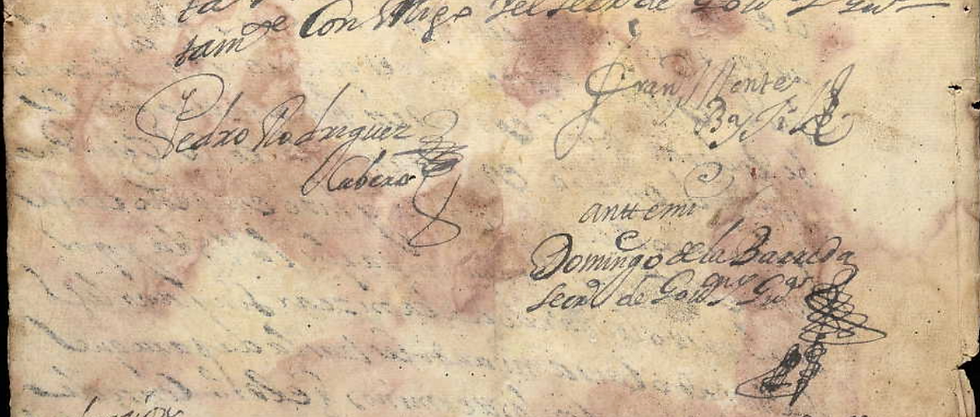
Source:
Spanish Archives of New Mexico, Series 2, 1697-1701: Twitchell 63-78 (Serial 10101)
No. 71(1), fol. 38v-40v, (Images 279-283). Available on Ancestry.com at: https://www.ancestry.com/imageviewer/collections/8831/images/40673_n2546857_0083-00206


Comments