
Clues about the lineage of Conquistador Antonio de Carvajal
- Oct 16, 2025
- 4 min read
Conquistador Antonio de Carvajal was a native of the city of Zamora, Spain (see my four-part blog series on his life). In 1616, his grandson Juan de Cervantes Casaus, the son of Gonzalo Gómez de Cervantes and Catalina de Tapia Carvajal, applied to become a Knight of the Order of Santiago, a prestigious military order. As part of the application process, officials investigated his limpieza de sangre (“cleanliness” of his lineage) to ensure neither he nor his ancestors were Moors, Jews or had been punished by the Inquisition.
The investigation was extremely thorough. The king, through his Royal Council of the Military Orders, named two existing members of the order—Don Álvaro de Quiñones and Licenciado Gregorio Lacuesta Alcántara—to carry out the investigation. They traveled from Valladolid to Zamora to identify and interview witnesses who knew the Carvajal family and could provide information about their background. Although witnesses did not name Antonio de Carvajal’s parents, they stated that he was from a well-known hijo d’algo family that had lived on the Calle de Riego. Eventually, the investigators were able to locate and interview witnesses who stated that they were direct descendants of Antonio de Carvajal’s siblings. The results of their investigation are shown in the chart below. Carvajal descendants interviewed are marked (†).
Carvajal Family Tree

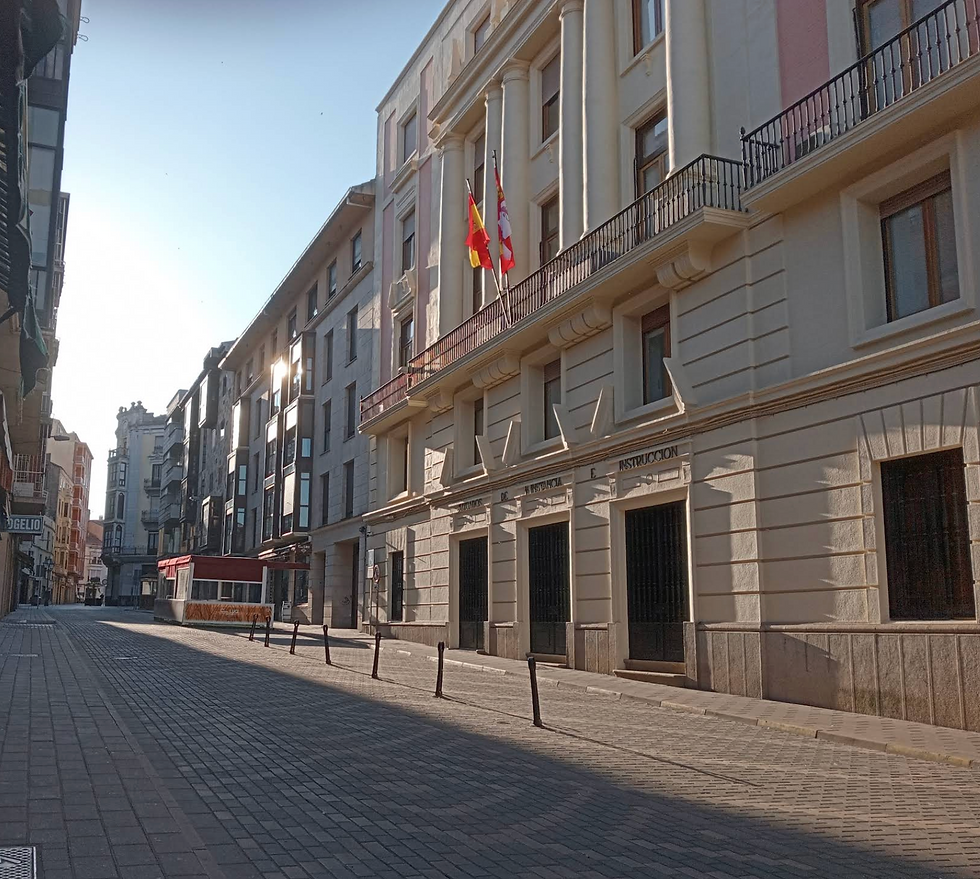
A view of the Calle de Riego in Zamora as it looks today, from Google Maps.
Residents of Zamora—even those not related to the Carvajals— were remarkably well-informed about the Carvajal family of Mexico City, likely indicating that Antonio had kept in touch with his family in Zamora after the conquest. One witness stated that he had heard Gregorio and Hernando de Carvajal say on numerous occasions, when they were alive, that they had a relative named Cervantes Casaus who was very rich and belonged to one of Mexico’s most prominent families. Another witness stated that Antonio de Carvajal had gone to the Indies along with the witness’s great-uncles Juan de Villagómez and Francisco Rodríguez de la Cava.
The Carvajal family of Zamora provided information confirming that the Conquistador Antonio de Carvajal was indeed a relative. Beatriz Ortiz de Carvajal stated Antonio de Carvajal was the name of the brother of her great-grandmother Catalina Fernández de Carvajal. Beatriz’s husband mentioned two of her “uncles,” Diego and Mateo Noguerol de Carvajal (the former was a priest), but he said that Diego had been born in 1500, so they must have been her great-uncles.
Gregorio de Carvajal said that the conquistador Antonio de Carvajal was the brother of his great-grandfather Alonso Pérez de Carvajal. He had also been informed about the marriage of Antonio’s eldest son to a woman with the surname Sosa, in Mexico, and the couple had many descendants (this is corroborated by other records, which show Antonio de Carvajal II married María de Sosa). He also knew that Antonio’s daughter María de Carvajal had married and had many descendants, and that another daughter, Catalina de Carvajal, had married Gonzalo Gómez de Cervantes, a gentleman from Seville (the Cervantes family was from Seville, but Gonzalo was actually born in Mexico City).
The investigators next examined an executory letter in Gregorio’s possession certifying the nobility of his great-grandfather Alonso Pérez de Carvajal. The letter was executed in Valladolid on 28 February 1526 by the scribe Juan Fernández de Salinas. It acknowledged that officials of Zamora had examined witnesses to prove the nobility of the family and registered Alonso as an hijo d’algo in 1525, although none of the documents made any reference to Antonio. The investigators’ report concluded with the statement, “According to some of the aforementioned witnesses, mainly relatives, Alonso Pérez de Carvajal seems to have been the brother of Antonio de Carvajal, who, according to what the report claims, was already in the Indies and participated in the conquest of Mexico.” A copy of the executory letter is available online at the Portal de Archivos Españoles (PARES), here.
One question that remains is, what were the names of Antonio de Carvajal’s parents? The only document that names them as Pedro González de Carvajal and Isabel Delgadillo is a report from circa 1545 on the conquistadors and their families (see this blog post). Yet the investigation in Zamora in 1616 named one of their sons as Alonso Pérez de Carvajal and a daughter as Catalina Fernández de Carvajal (although the Fernández was an abbreviation and could have been a scribal error). Was the “González” surname mistakenly recorded in 1545? This seems like a possibility, as the executory letter of nobility from 1526 examined by the investigators listed “Pérez” as the surname. The descendants of the Carvajals in Zamora also reported it as Pérez. Another possibility is that Alonso used a different surname than his father, a practice that was not uncommon. Further research using the names in the family tree above may yield more clues about Antonio’s lineage.
Source:
“Cervantes y Casaus, Juan de,” Archivo Histórico Nacional, OM-CABALLEROS_SANTIAGO, Exp. 1908, Portal de Archivos Españoles (PARES), (https://pares.mcu.es/ParesBusquedas20/catalogo/description/1341085?nm)
Great info. Thanks for sharing.